By Dr. Kayla Wright, DPM
Ever wish you could bring a podiatrist shoe shopping?
Between walls of sneakers, claims of “maximum comfort,” and sandals that look perfect for the weekend, choosing the right shoe can feel surprisingly complicated.
The good news: there usually is not one universally “best” shoe.
The best choice depends on your foot, your activity, your symptoms and—if you wear them—your orthotics.
Consider this your podiatrist’s shoe-shopping guide.
Take Dr. Wright’s Shoe Guide Shopping
Free PDF · Save it to your phone for your next shoe-shopping trip.
Start with what you will actually do in the shoe
Before choosing a brand, ask:
What am I buying this shoe for?
Walking the neighborhood, working a long shift, running, hiking and playing sports all place different demands on footwear.
A shoe that works well for one activity may not be the right choice for another.
Then think about your own feet:
- Do you have heel or forefoot pain?
- Do your toes feel crowded?
- Does one shoe wear out faster than the other?
- Do your feet swell during the day?
- Do you wear custom orthotics?
- Do you need more stability, cushioning or room?
Foot structure matters too. Someone with high arches may need different footwear features than someone with flatter feet, depending on symptoms, activity and mechanics.
Start with the activity. Then match the shoe to your foot.
Give your toes room
The toe box is the front portion of the shoe where your toes sit.
Your toes should be able to rest comfortably without being squeezed from the sides or pressed from above.
When trying on shoes:
- Wear the socks you normally use
- Try on both shoes
- Stand and walk around
- Make sure the shoe fits your larger foot
- Check width as well as length
- Shop later in the day if your feet tend to swell
Do not assume that buying a longer shoe will solve a width problem.
What about “foot-shaped” toe boxes?
Some Altra and Topo Athletic models are designed with a roomier, more anatomically shaped toe box.
That can be useful for people who prefer more space around the toes, but fit and features vary by model.
A wide-looking shoe is not automatically the right shoe for every foot.
Athletic shoes to put on your try-on list
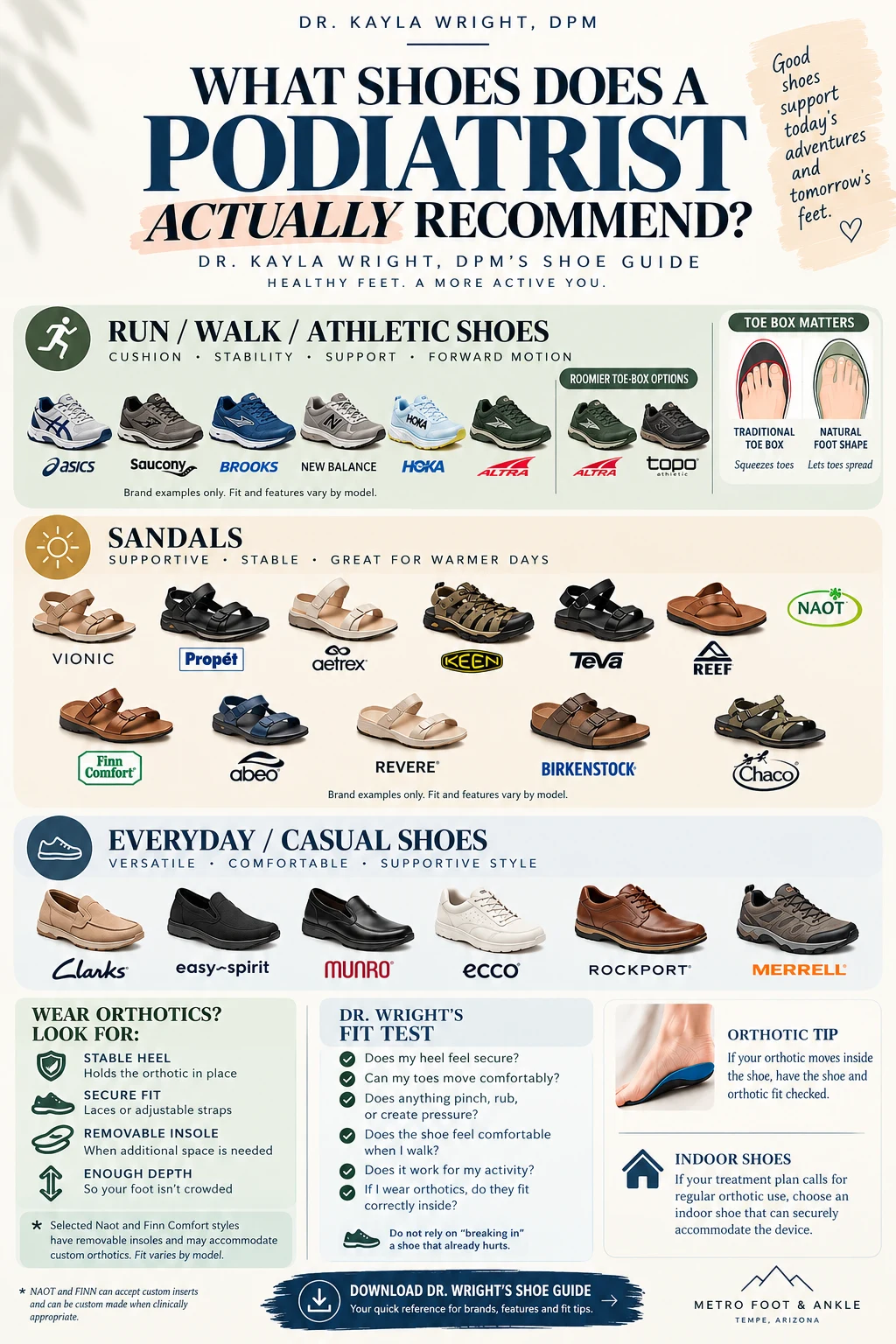
Brands featured in Dr. Wright’s guide include:
- ASICS
- Saucony
- Brooks
- New Balance
- HOKA
- Altra
- Topo Athletic
These are brand examples, not blanket recommendations. Cushioning, stability, width, heel-to-toe drop and overall fit can differ substantially between models from the same company.
The goal is not to buy a particular logo.
It is to find the model that works for your activity and your foot.
Sandals can be supportive too
A sandal does not have to mean a thin, completely flat flip-flop.
Brands to explore include:
- Vionic
- Propet
- Aetrex
- KEEN
- Teva
- Reef
- Naot
- Finn Comfort
- ABEO
- Revere
- Birkenstock
- OOFOS
- Chaco
For longer periods of walking, look for a sandal that stays securely on the foot.
Useful features may include:
- Adjustable straps
- A stable sole
- A secure heel or rear strap
- Enough width for the forefoot
- A footbed that feels comfortable under your arch
Again, fit and features vary by model.
Everyday and casual shoes
You do not have to wear a running shoe everywhere.
For work, travel, errands or everyday use, brands in the guide include:
- Clarks
- Easy Spirit
- Munro
- ECCO
- Rockport
- Merrell
Choose the style based on what your day actually looks like.
Someone sitting at a desk has different footwear needs than someone spending an eight-hour shift standing on hard flooring.
Wear orthotics? Bring them shoe shopping
This is one of the most important tips in the entire guide:
Bring your orthotics with you when you try on shoes.
An orthotic changes how much room your foot needs inside the shoe.
Look for:
A stable heel
The back of the shoe should hold your heel securely without excessive slipping.
A secure closure
Laces, straps or another adjustable closure can help keep both your foot and orthotic in position.
A removable insole
Removing the factory insole can create additional room for a prescribed orthotic when appropriate.
Enough depth
Your foot should not feel squeezed against the top or sides of the shoe after the orthotic is inserted.
Selected Naot and Finn Comfort styles have removable insoles and may accommodate custom orthotics. Fit varies by model.
If your orthotic moves inside the shoe
Have the shoe and orthotic fit checked rather than automatically trying to secure it yourself.
If your treatment plan calls for regular orthotic use, consider an indoor shoe that can securely accommodate the device rather than walking barefoot around the house.
Learn more about custom orthotics.
Dr. Wright’s quick fit test
Before heading to the register, ask yourself:
- Does my heel feel secure?
- Can my toes move comfortably?
- Does anything pinch, rub or create pressure?
- Does the shoe feel comfortable while I walk?
- Does it work for the activity I bought it for?
- If I wear orthotics, do they fit properly inside?
If the answer to one of these is no, try another size, width or model.
Do shoes need to be “broken in”?
A shoe may soften somewhat with use, but do not rely on breaking in a shoe that already hurts.
Painful pressure, rubbing or significant toe crowding in the store is a reason to reconsider the fit.
Your shoes should feel reasonably comfortable when you buy them.
So, what is the best shoe?
The answer is less exciting than naming one winning brand—but much more useful.
The best shoe is the one that fits your foot, your activity and your treatment plan.
The most expensive shoe is not automatically the best.
The most cushioned shoe is not automatically the best.
And the shoe your friend loves may feel completely different on your foot.
Use brands to narrow the search. Use fit to make the final decision.
Save the Shoe Guide Before You Shop
Download Dr. Wright’s quick-reference guide with athletic, sandal and casual shoe brands, toe-box tips and orthotic-friendly features.
Still uncomfortable no matter what shoes you buy?
If heel pain, arch pain or forefoot pain keeps following you from pair to pair, the problem may not be the shoe alone.
A foot and ankle evaluation can help identify whether factors such as foot structure, pressure distribution, tendon problems, arthritis or another condition are contributing.
Need help finding what your feet actually need?
Schedule a foot and ankle evaluation with Dr. Kayla Wright at Metro Foot & Ankle in Tempe.
Frequently Asked Questions
What shoe brands do podiatrists recommend?
There is no single best brand for everyone. Dr. Wright’s try-on list includes brands such as Brooks, ASICS, New Balance, HOKA, Saucony, Altra and Topo Athletic, but fit and features vary by model.
Should I buy a bigger shoe if my feet are wide?
Not necessarily. Extra length does not correct inadequate width. Look for a shoe available in the appropriate width and make sure your toes are not crowded.
Can custom orthotics fit in any shoe?
No. The shoe needs enough depth and internal space to accommodate the orthotic comfortably. A removable factory insole may provide additional room in some shoes.
Should new shoes hurt while I break them in?
No. Shoes may soften somewhat with wear, but significant rubbing, pressure or pain when you try them on is a reason to reconsider the fit.
Sources
- American Academy of Orthopaedic Surgeons (AAOS/OrthoInfo). Tight Shoes and Foot Problems (opens in a new tab). Updated 2025.
- American Academy of Orthopaedic Surgeons. Athletic Shoe Selection and Fit Guidance (opens in a new tab).
- Buldt AK, Menz HB. Incorrectly fitted footwear, foot pain and foot disorders: a systematic search and narrative review of the literature (opens in a new tab). Journal of Foot and Ankle Research. 2018;11.
- Gronda A, Chen C, Abraham S, et al. Lower Limb Orthotics/Therapeutic Footwear (opens in a new tab). PM&R KnowledgeNow. Updated 2026.
Brand names are provided as examples only. Fit, construction and features vary by model. This article is for general education and does not replace individualized medical evaluation or footwear recommendations.