
By Dr. Kayla Wright, DPM
If your heel or tendon has been bothering you for months, you have probably already heard a long list of suggestions:
Stretch it. Rest it. Change shoes. Try inserts. Get an injection. Wait longer.
And yet it still hurts.
That is usually when patients start asking us about platelet-rich plasma, or PRP.
PRP can be a reasonable treatment option in the right situation. But the important question is not simply whether PRP is available.
It is why the tissue still hurts in the first place — and whether PRP fits that diagnosis.
Still dealing with heel or tendon pain?
Schedule an evaluation with Dr. Kayla Wright to determine what is causing the problem and which treatment options make sense for you.
What is PRP?
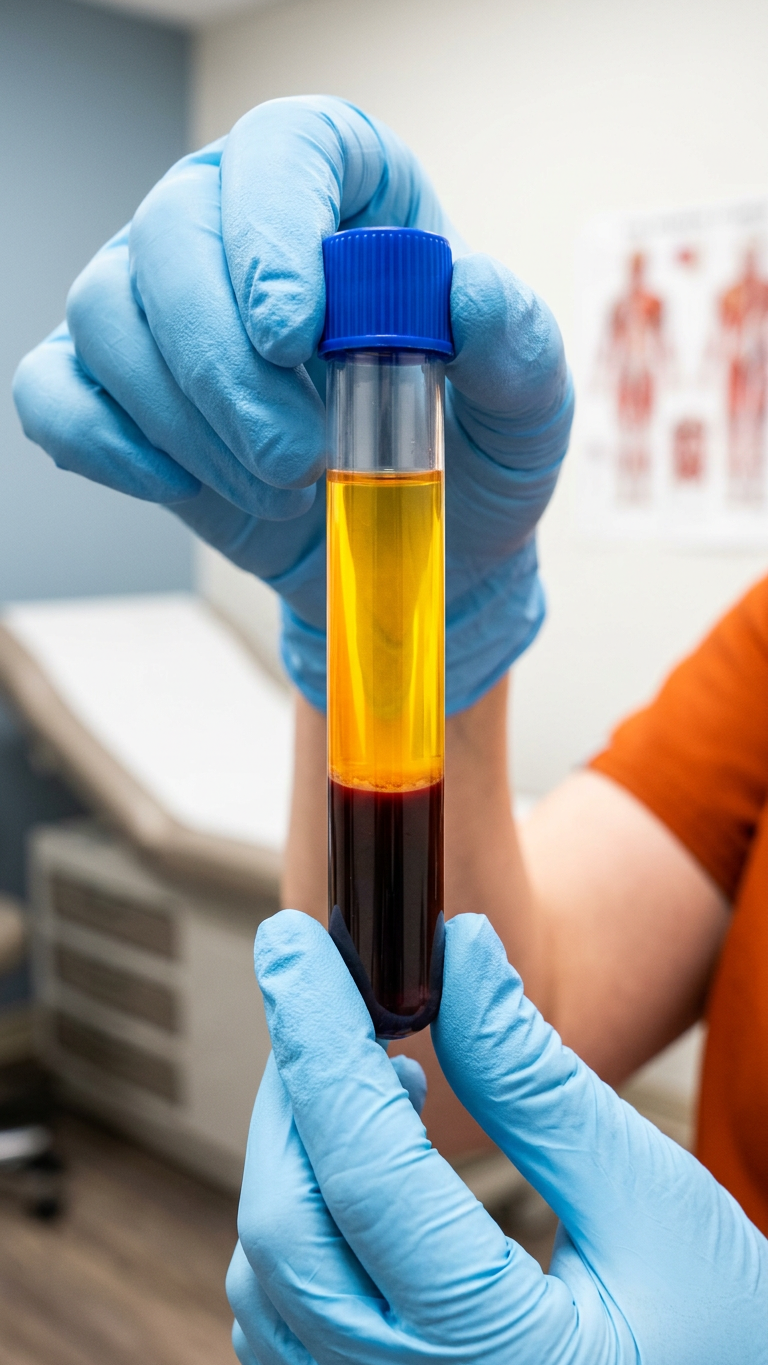
PRP stands for platelet-rich plasma.
A small amount of your own blood is collected and processed in a centrifuge to separate and concentrate the platelet-containing portion. That preparation is then injected into the targeted area.
Platelets are best known for helping blood clot, but they also contain proteins and signaling molecules involved in the body's normal tissue-repair response.
That does not mean PRP automatically regenerates damaged tissue, cures an injury, or guarantees that surgery can be avoided.
PRP is one treatment option that may be considered as part of a larger plan.
Watch Dr. Wright discuss PRP on Instagram (opens in a new tab)
What foot and ankle problems may be considered for PRP?
PRP has been studied for several musculoskeletal conditions involving the foot and ankle.
Depending on your diagnosis, examination, imaging when needed, and treatments already attempted, PRP may be discussed for conditions such as:
- Chronic plantar fasciitis or persistent plantar heel pain
- Selected Achilles tendon problems
- Other chronic tendon injuries
- Selected ligament injuries
- Certain joint conditions
The word selected matters.
Two people can point to almost exactly the same place on the heel and have different underlying problems.
PRP will not fix every cause of heel pain. Neither will stretching, orthotics, shockwave therapy, cortisone, laser treatment, or surgery.
The diagnosis comes first.
PRP for plantar fasciitis and chronic heel pain
One of the more common reasons patients ask about PRP is persistent plantar fasciitis or plantar heel pain.
Plantar fasciitis often causes pain near the bottom of the heel and may be especially noticeable with the first steps after getting out of bed or after sitting.
Most patients do not begin treatment with PRP.
Initial care may include a combination of:
- Activity modification
- Calf and plantar fascia stretching
- Supportive footwear
- Prescription or over-the-counter orthotics when appropriate
- Strength and mobility work
- Other office-based treatments
But some cases become persistent.
Research comparing PRP with corticosteroid injections for plantar fasciitis suggests PRP may provide better pain or functional outcomes at some later follow-up points. Results vary among studies, and PRP is not universally superior at every point in recovery.
That makes it most relevant as a discussion for appropriately selected patients with persistent symptoms, not as something every patient with heel pain needs.
Heel pain still coming back?
If the same heel pain keeps returning despite appropriate treatment, the next step may be reassessing the diagnosis and treatment plan.
What about PRP for Achilles tendon pain?
PRP has also been studied for Achilles tendinopathy.
The evidence is less definitive than it is for some other uses. Current research has not established PRP as a guaranteed solution for Achilles tendon problems.
That distinction matters because “Achilles pain” can represent different conditions, including:
- Midportion Achilles tendinopathy
- Insertional Achilles tendinopathy
- Partial tendon injury
- Retrocalcaneal bursitis
- Haglund-related irritation
- Other causes of posterior heel pain
Treatment should be based on what is actually injured, not simply where it hurts.
For Achilles problems, proper loading, rehabilitation, footwear, and biomechanics may remain important whether or not an injection is considered.
Learn more about Achilles tendon conditions.
Where does PRP fit compared with other treatments?
PRP is not automatically the “next step” after conservative care.
Depending on the diagnosis, treatment may instead include:
- Continued rehabilitation or activity modification
- Orthotic support
- Shockwave therapy
- Immobilization
- Diagnostic imaging
- A change in training or work load
- Another injection option
- Surgery when appropriate
The goal is not to force every persistent injury into the same treatment.
It is to identify the problem and choose the intervention with a reasonable risk-benefit profile for that patient.
Does PRP hurt?
PRP is still an injection, and temporary soreness at the treatment site can occur afterward.
Other risks depend on the treatment location, technique, and individual patient factors. No injection is risk-free.
Before treatment, Dr. Wright can review what to expect, the potential risks, and whether PRP is reasonable for your diagnosis.
How quickly does PRP work?
PRP should not be thought of as an instant pain-relief injection.
When patients respond, improvement may occur gradually rather than immediately.
Recovery depends on factors including:
- The condition being treated
- How long it has been present
- Severity of the injury
- Activity level
- Overall health
- Biomechanical factors
- Rehabilitation and activity progression
This is another reason the underlying cause matters. An injection cannot indefinitely compensate for continued overload or an untreated mechanical problem.
PRP vs. cortisone: are they the same thing?
No.
Corticosteroid injections use anti-inflammatory medication. PRP is prepared from a concentrated portion of the patient's own blood.
They work differently and have different indications, limitations, and risks.
For plantar fasciitis, both corticosteroid injections and PRP have been studied. Some research suggests PRP may have an advantage at later follow-up periods, but treatment should be individualized.
Corticosteroid injections also require particular caution around tendons. Injection directly into the Achilles tendon is generally avoided because of concern for tendon weakening and rupture.
The decision should therefore start with the diagnosis rather than simply choosing one injection over another.
Do I need PRP — or something else?
This is the question we would rather answer.
Sometimes PRP may be reasonable.
Sometimes the better next step is better mechanical support, a different rehabilitation strategy, shockwave therapy, immobilization, imaging, surgery, or simply more time with the right conservative plan.
You do not need to decide before your appointment that you want an injection.
Start with the evaluation.
Who should consider a PRP consultation?
It may be worth discussing PRP with a foot and ankle physician if:
- Your heel or tendon pain has become persistent
- Symptoms return when you resume activity
- You have already tried appropriate conservative treatment
- Your diagnosis remains unclear
- You want to understand nonsurgical options before considering surgery
- You have been diagnosed with plantar fasciitis or tendinopathy but are not improving as expected
Persistent foot or ankle pain? Find out what is causing it.
If heel, Achilles, or other foot and ankle pain is keeping you from walking, working, exercising, or participating in your sport normally, schedule an evaluation with Dr. Kayla Wright, DPM at Metro Foot & Ankle in Tempe.
Metro Foot & Ankle sees patients from Tempe, Chandler, Mesa, Gilbert, Scottsdale, and communities throughout the East Valley.
Ready to get the problem evaluated?
Book online 24/7 through Metro Foot & Ankle's DrChrono scheduler.
Metro Foot & Ankle
3231 S Country Club Way, Suite 108
Tempe, AZ 85282
480-831-0700
Monday-Friday, 8:00 a.m.-5:00 p.m.
Frequently asked questions
Is PRP good for plantar fasciitis?
PRP may be considered for some patients with persistent plantar fasciitis or chronic plantar heel pain. Research suggests it may provide meaningful longer-term improvement for some patients, including in comparisons with corticosteroid injection, but results vary and treatment should be individualized.
Can PRP help Achilles tendonitis?
PRP has been studied for Achilles tendinopathy, but the evidence is mixed. An examination is important because several different conditions can cause pain around the Achilles tendon and back of the heel.
Is PRP the same as a cortisone injection?
No. Cortisone is an anti-inflammatory medication. PRP is prepared from a concentrated portion of the patient's own blood. They work differently and have different indications and risks.
How many PRP injections will I need?
There is no universal number. Treatment protocols vary depending on the diagnosis, severity of the problem, response to treatment, and the physician's clinical judgment.
Does insurance cover PRP injections?
Coverage varies by insurance plan and indication, and some plans may consider PRP investigational or non-covered. Patients should verify their specific benefits and expected out-of-pocket cost before treatment.
Where can I get PRP for foot or ankle pain in Tempe?
Metro Foot & Ankle evaluates and treats foot and ankle conditions at 3231 S Country Club Way, Suite 108, Tempe, Arizona. Appointments with Dr. Kayla Wright can be scheduled online through the Metro Foot & Ankle booking page or by calling 480-831-0700.