
By Dr. Kayla Wright, DPM
That distinction matters because fungal treatment can take months. Before committing to oral medication, topical therapy, or a device-based treatment, the highest-value question is often: Is fungus actually present?
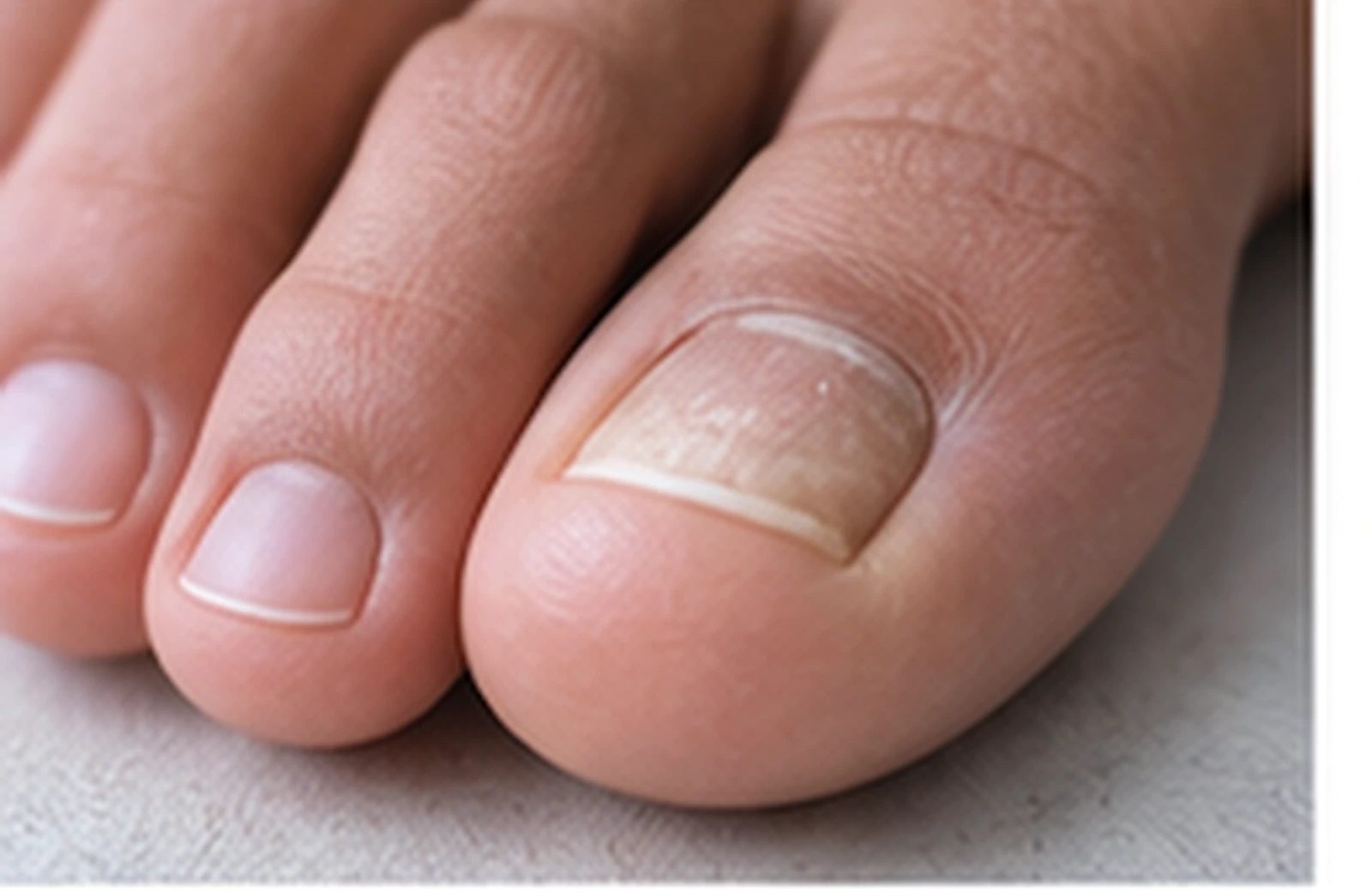
What toenail fungus commonly looks like
Onychomycosis can produce:
- yellow, white, brown, or opaque discoloration
- thickening of the nail plate
- crumbly debris under the nail
- separation of the nail from the nail bed (onycholysis)
- rough or brittle texture
- progressive involvement of more of the nail
- multiple affected nails in some patients
Distal lateral subungual onychomycosis—the most common pattern—often begins at the outer or far edge and progresses toward the nail root.
But none of those findings is exclusive to fungus.
What traumatic nail damage can look like
Trauma can come from one obvious event—such as dropping something on the toe—or from hundreds of small impacts.
Common examples include:
- repeated toe contact with the front of a running shoe
- tight cleats, work boots, or dress shoes
- long downhill hikes
- court sports with abrupt stops
- a prior black toenail that later becomes thick or irregular
Traumatic nail changes may include:
- dark purple, brown, or black blood under the nail after injury
- nail lifting
- ridging
- thickening
- splitting
- irregular regrowth
- a stable abnormality limited to one repeatedly traumatized toe
A chronic trauma nail can lose the dramatic “black toenail” appearance and eventually look yellow, thick, or dystrophic—very similar to fungus.
The clues that make fungus more likely
No single clue confirms onychomycosis, but suspicion rises when:
- the change progresses slowly without a clear injury
- debris accumulates under the nail
- several nails become involved
- athlete's foot is also present
- the affected portion gradually advances toward the nail matrix
- risk factors such as older age, diabetes, immune compromise, or repeated fungal exposure are present
The clues that make trauma more likely
Trauma becomes more plausible when:
- one nail changed after a specific injury
- symptoms began after a new shoe or major training increase
- the same toe repeatedly hits the shoe
- there is a history of black toenail or subungual bleeding
- the abnormal portion is gradually growing out while healthier nail emerges from the base
- other toenails remain completely normal
Again, these are clues—not a lab diagnosis.
Why appearance alone can lead to the wrong treatment
Many nail disorders mimic fungus. Differential diagnoses include:
- traumatic nail dystrophy
- psoriasis
- lichen planus
- eczema-related nail changes
- bacterial colonization
- age-related nail thickening
- tumors or pigmented lesions in less common cases
The American Academy of Family Physicians recommends confirmatory testing before treatment when possible, particularly because oral antifungal therapy exposes patients to medication risks and drug interactions.
A consensus project on onychomycosis likewise identified microscopy and fungal culture as common methods used to establish the diagnosis, with molecular testing also available in some settings.
How toenail fungus is tested
Depending on the clinical situation, testing may include:
Potassium hydroxide (KOH) preparation
A nail sample is examined microscopically for fungal elements. It can provide relatively rapid evidence of fungus.
Fungal culture
Culture can help identify an organism but takes longer and can have false-negative results.
Histopathology / PAS staining
Clipped nail material can be processed and stained to look for fungal structures in the nail.
Molecular testing
PCR-based methods can identify fungal genetic material more quickly in some settings, though availability and cost vary.
Testing strategy depends on the nail, treatment being considered, and clinical suspicion.
Why confirming fungus is especially important before oral medication
Oral terbinafine is generally considered the most effective first-line oral treatment for dermatophyte onychomycosis when it is appropriate for the patient. But it is still a prescription systemic medication with contraindications, potential drug interactions, and monitoring considerations.
Treating a trauma nail with months of antifungal medication exposes the patient to burden without treating the cause.
The same logic applies to topical and device-based treatment: the treatment should match the diagnosis.
Can trauma and fungus happen at the same time?
Yes.
A repeatedly damaged nail can become more vulnerable to fungal colonization, and a fungal nail can be further traumatized by shoe pressure. The clinical question is not always “one or the other.” Sometimes testing identifies fungal infection in a nail that also has significant mechanical damage.
That matters because removing fungal burden will not fix an ongoing shoe-fit or toe-impact problem.
What if the nail is black?
A black toenail after obvious trauma is often a subungual hematoma—blood beneath the nail. But unexplained or persistent dark pigmentation deserves attention, especially if:
- there was no injury
- pigment begins near the nail matrix
- a dark band is changing or widening
- pigment extends onto surrounding skin
- the nail is progressively deforming
Those features require evaluation rather than assuming “fungus” or “a bruise.”
How long does a damaged toenail take to grow out?
Toenails grow slowly. A great toenail can take many months—and often a year or longer—to replace itself from base to tip.
That slow growth is why both trauma recovery and successful fungus treatment can appear frustratingly gradual. The most useful sign is often healthy new nail growing from the base, not whether the damaged tip looks normal immediately.
Frequently asked questions
Can a runner's black toenail turn yellow later?
Yes. After trauma, the nail may lift, thicken, or regrow irregularly. As old blood and damaged nail grow out, the appearance can evolve and mimic fungal dystrophy.
Can only one toenail have fungus?
Yes. Multiple nails make fungus more suspicious, but a single nail can be infected. One-nail disease should still be interpreted alongside trauma history and testing.
Is athlete's foot related to toenail fungus?
Yes. The same dermatophyte organisms can infect skin and nails, and untreated tinea pedis may contribute to reinfection. Treating skin fungus can be part of reducing recurrence.
Can a podiatrist tell just by looking?
Sometimes the pattern is highly suggestive, but appearance is not perfectly specific. Testing is useful when the diagnosis is uncertain or when treatment carries meaningful cost, duration, or medication risk.
Will a trauma nail become normal again?
It may if the nail matrix was not permanently damaged and the mechanical cause is corrected. Significant matrix injury can produce long-term nail-shape changes.
Nail diagnosis in Tempe, Arizona
If you have a thick, discolored, or damaged nail and are unsure whether it is fungal, traumatic, or both, Metro Foot & Ankle can evaluate the pattern and determine whether testing is appropriate before treatment. Learn more about toenail fungus or request an evaluation in Tempe.
This article is for general educational purposes and does not replace individualized medical advice, diagnosis, or treatment.
Sources
- Westerberg DP, Voyack MJ. Onychomycosis: Rapid Evidence Review. American Family Physician. 2021;104(4):359-367. https://www.aafp.org/pubs/afp/issues/2021/1000/p359.html (opens in a new tab)
- Lipner SR, Scher RK, et al. Onychomycosis: Recommendations for Diagnosis, Assessment of Treatment Efficacy, and Specialist Referral. The CONSONANCE Consensus Project. 2022. https://pubmed.ncbi.nlm.nih.gov/35262878/ (opens in a new tab)
- Nenoff P, et al. S1 Guideline onychomycosis. 2023. https://pubmed.ncbi.nlm.nih.gov/37212291/ (opens in a new tab)
- Litaiem N, Mnif E, Zeglaoui F. Dermoscopy of Onychomycosis: A Systematic Review. Dermatology Practical & Conceptual. 2023;13(1):e2023072. https://pubmed.ncbi.nlm.nih.gov/36892372/ (opens in a new tab)