
By Dr. Kayla Wright, DPM
But the timing alone is not enough to diagnose it. Where the heel hurts, what the pain feels like, what changed before it started, and how the foot behaves with activity can separate plantar fasciitis from Achilles problems, nerve irritation, a stress injury, or other causes of heel pain.
The location and pattern of your heel pain matter
A useful first question is not simply, “Does it hurt in the morning?” It is, “Exactly where does it hurt, and what happens after I start moving?”
| Pain pattern | What it may suggest |
|---|---|
| Pain under or just inside the heel; worst with first steps; eases after walking | Plantar fasciitis is more likely |
| Pain at the back of the heel, especially with shoe pressure or pushing off | Achilles insertional pain or bursitis may be more likely |
| Burning, tingling, numbness, or electric-type pain | Nerve irritation deserves consideration |
| Deep, focal heel pain that worsened after a sudden jump in running, walking, or impact | A bone stress injury may need to be ruled out |
| Central “bruised heel” pain that is worse barefoot on hard surfaces | Heel fat-pad irritation may be part of the picture |
These are clues, not a self-diagnosis. Several heel conditions overlap, and more than one problem can exist at the same time.
Why plantar fasciitis hurts with the first steps after rest
The plantar fascia is a strong band of connective tissue that runs from the heel toward the toes and helps support the arch as the foot accepts and transfers load.
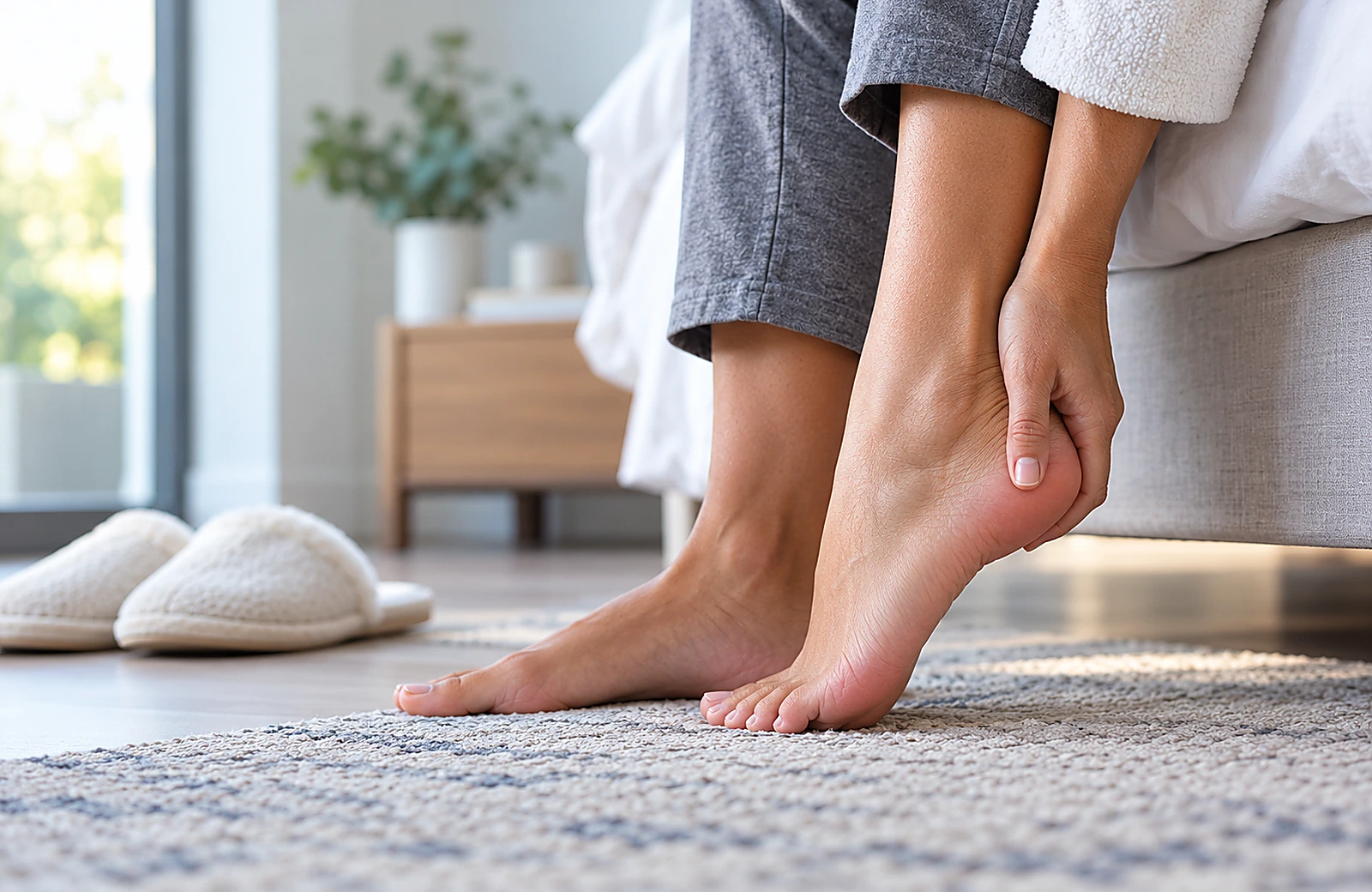
With plantar fasciitis, the tissue near its heel attachment becomes sensitive to repeated loading. After a period of rest, the first few weight-bearing steps suddenly ask that irritated tissue to accept body weight again. That transition from rest to load can produce the familiar sharp “start-up” pain.
The same pattern can occur after sitting through a meeting, driving for a while, or getting up from the couch. The pain may ease as you move, then return later after prolonged standing, walking, or exercise.
One important distinction: feeling better after five minutes of walking does not necessarily mean the problem is gone. The tissue may simply tolerate movement better once it is loaded and moving.
What commonly contributes to plantar heel pain?
Plantar fasciitis rarely comes down to one isolated cause. Risk and load can build from several directions, including:
- a rapid increase in running, walking, hiking, court sports, or time on your feet
- limited ankle dorsiflexion or tight calf musculature
- prolonged standing on hard surfaces
- footwear that does not match the demands of the activity or the individual foot
- changes in training volume, intensity, terrain, or recovery
- foot structure and movement patterns that change how load is distributed
- higher overall mechanical load on the foot
The useful question is therefore not just “What caused my plantar fasciitis?” but “What changed the amount of stress going through my heel, or reduced its ability to tolerate that stress?”
What can you try before your first steps tomorrow morning?
For uncomplicated plantar-fasciitis-type symptoms, a few low-risk measures are reasonable while you monitor the pattern.
1. Gently stretch before standing
Before putting full weight on the foot, gently move the ankle and stretch the calf and plantar fascia. Current clinical guidelines support plantar-fascia-specific and calf stretching as part of plantar fasciitis care.
The stretch should feel controlled. It should not reproduce sharp pain, numbness, or electric symptoms.
2. Avoid going straight from bed to barefoot hard flooring
If hard flooring predictably triggers the first-step pain, put on supportive footwear before walking around the house. The goal is not to become dependent on one particular shoe; it is to reduce unnecessary heel loading while the area is irritated.
3. Adjust load instead of stopping all movement automatically
If your pain appeared after doubling your walking distance, adding hills, starting pickleball, increasing run mileage, or spending much longer on your feet, temporarily reducing the aggravating load may make more sense than either ignoring the pain or stopping every form of activity.
A good rule is to watch what the heel does during activity and the next morning. A repeated spike in symptoms after the same load is useful information.
4. Consider support as part of a plan, not the entire plan
Foot orthoses or inserts can be useful for selected patients, particularly when combined with other evidence-based care. They are not a universal cure, and current guidelines do not support treating plantar fasciitis with an orthotic device as the only intervention.
For patients whose symptoms and mechanics warrant it, custom orthotics may be one component of treatment after evaluation.
5. Night splints may help persistent first-step pain
For people who consistently have significant pain with the first steps in the morning, the 2023 clinical practice guideline supports a one- to three-month trial of a night splint. This is not necessary for everyone, but it can be useful when first-step pain is a dominant symptom.
When morning heel pain may not be plantar fasciitis
The diagnosis deserves a closer look when the pattern does not fit.
Consider an evaluation sooner if you have:
- pain primarily at the back of the heel rather than underneath it
- burning, tingling, numbness, or pain that travels
- marked swelling, redness, warmth, or an open wound
- heel pain after a fall, hard landing, or other injury
- highly localized bone pain after a major increase in impact activity
- symptoms that are progressively worsening rather than stabilizing
- pain that is changing the way you walk
- persistent symptoms despite a reasonable period of activity modification and conservative care
Posterior heel pain, for example, may involve the Achilles tendon, while neurologic symptoms can point away from a straightforward plantar-fascia problem.
How a foot and ankle evaluation helps
Plantar fasciitis is usually a clinical diagnosis. Imaging is not automatically required for every patient with morning heel pain.
A focused evaluation typically looks at:
- the exact location of tenderness
- whether the pain is reproduced at the plantar-fascia attachment
- ankle and calf mobility
- foot structure and mechanics
- recent changes in training, work, or daily activity
- footwear
- nerve symptoms
- signs that suggest a stress injury or another diagnosis
Imaging becomes more useful when the story is atypical, symptoms are severe or persistent, trauma is involved, or the examination raises concern for another condition.
That distinction matters because treating every case of heel pain as plantar fasciitis can delay the right diagnosis.
What if the pain really is plantar fasciitis?
Most plantar fasciitis is managed without surgery. Evidence-based treatment usually starts with a combination of strategies selected for the individual problem rather than one “magic” intervention.
Depending on the evaluation, care may include:
- plantar-fascia and calf stretching
- progressive strengthening and load management
- taping
- footwear modification
- inserts or orthoses when appropriate
- a night splint for persistent first-step pain
- additional treatment options for symptoms that remain persistent despite a well-executed conservative program
The important point is that morning pain is a pattern to interpret, not merely a symptom to suppress. Identifying the tissue involved and the loads driving it makes the treatment plan much more specific.
Frequently asked questions
Why does my heel also hurt when I stand up after sitting?
Plantar fasciitis commonly produces “start-up” pain after any period of rest, not only after sleeping. If pain under the heel is sharp for the first few steps after sitting and then eases as you move, that pattern is consistent with plantar fascia irritation.
Is morning heel pain always plantar fasciitis?
No. Plantar fasciitis is a common cause and first-step pain is characteristic, but Achilles disorders, heel fat-pad problems, nerve irritation, stress injuries, and other conditions can overlap. Location and pain quality are important differentiators.
Does a heel spur cause morning heel pain?
Not necessarily. Heel spurs can coexist with plantar fasciitis, but the presence of a spur on an X-ray does not automatically prove that the spur is the source of pain. The clinical pattern and examination matter more than the finding alone.
Do I need an X-ray for morning heel pain?
Usually not for a straightforward plantar fasciitis presentation. Imaging may be appropriate when there has been trauma, the examination suggests a bone injury or another diagnosis, symptoms are atypical, or the problem is not improving as expected.
Morning heel pain evaluation in Tempe, Arizona
If your first few steps each morning keep hurting, the highest-value next step is not guessing which insert, stretch, injection, or procedure you need. It is determining why the heel is hurting in the first place.
Metro Foot & Ankle evaluates heel pain and plantar fasciitis in Tempe, serving patients throughout the East Valley. If symptoms are persistent, worsening, or interfering with walking, work, exercise, or sport, request an evaluation.
This article is for general educational purposes and does not replace individualized medical advice, diagnosis, or treatment.
Sources
- Koc TA Jr, Bise CG, Neville C, Carreira D, Martin RL, McDonough CM. Heel Pain – Plantar Fasciitis: Revision 2023. Journal of Orthopaedic & Sports Physical Therapy. 2023;53(12):CPG1–CPG39. https://doi.org/10.2519/jospt.2023.0303 (opens in a new tab)
- Latt LD, Jaffe DE, Tang Y, Taljanovic MS. Evaluation and Treatment of Chronic Plantar Fasciitis. Foot & Ankle Orthopaedics. 2020;5(1). https://pubmed.ncbi.nlm.nih.gov/35097359/ (opens in a new tab)
- Institute for Quality and Efficiency in Health Care (IQWiG). Overview: Pain under the foot (plantar fasciitis). InformedHealth.org / NCBI Bookshelf. Updated 2025. https://www.ncbi.nlm.nih.gov/books/NBK612672/ (opens in a new tab)
- Johns Hopkins Medicine. Plantar Fasciitis. https://www.hopkinsmedicine.org/health/conditions-and-diseases/plantar-fasciitis (opens in a new tab)