
By Dr. Kayla Wright, DPM
That difference—symptom control vs. structural correction—is the key to evaluating almost every bunion product advertised online.
Start with the goal: does the bunion need to look straighter, or does the foot need to feel and function better?
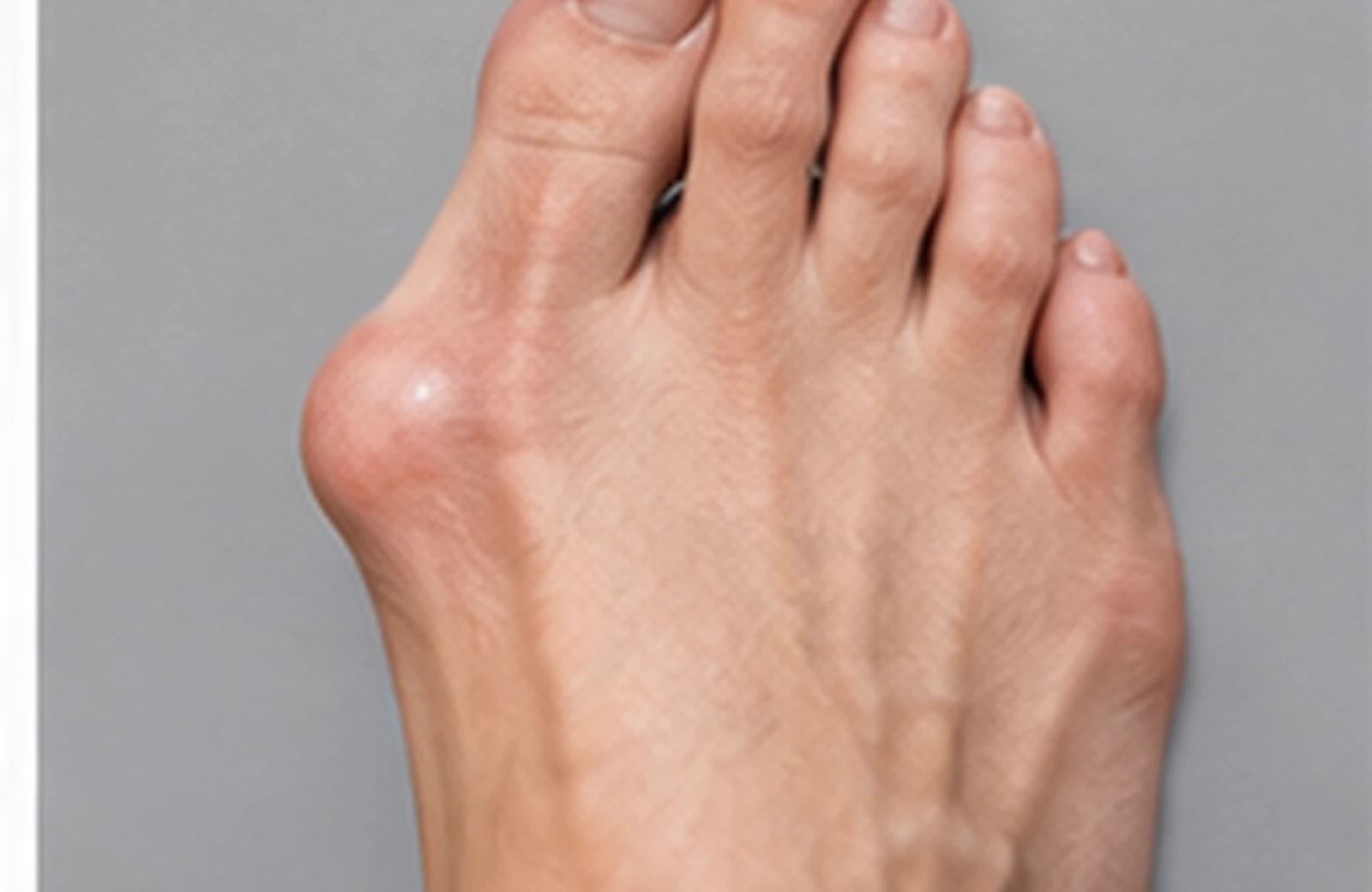
Hallux valgus occurs when the big toe and first metatarsal gradually move out of alignment. Some bunions look dramatic but cause little pain. Others are smaller and very symptomatic.
For nonsurgical care, practical goals include:
- reducing pressure over the bunion prominence
- making shoes comfortable again
- improving walking or exercise tolerance
- reducing secondary forefoot pressure
- managing inflammation during flares
- maintaining strength and mobility where appropriate
If those goals are met, there is no rule that says a visible bunion must be surgically corrected.
1. Footwear: often the highest-leverage first step
A bunion is especially likely to hurt when the shoe compresses the forefoot or rubs directly over the prominence.
Look for:
- adequate width across the forefoot
- a toe box that matches the shape of your toes rather than tapering sharply
- a softer upper over the bunion area
- enough depth to avoid pressure on overlapping or hammered toes
- a heel height and sole geometry that do not excessively shift pressure forward
The point is not that shoes “cause every bunion.” Genetics and foot structure contribute substantially. The point is that footwear can strongly influence whether an existing deformity is symptomatic.
What footwear can do: reduce pressure and irritation. What footwear cannot reliably do: realign an established bunion permanently.
2. Pads and sleeves: useful when the problem is friction
A simple bunion pad or gel sleeve may help when the primary complaint is rubbing against a shoe.
Padding works by changing the interface between the foot and shoe. If the actual problem is deep joint pain or severe transfer pressure beneath the forefoot, adding more material over the bump can sometimes make a tight shoe even tighter.
The test is practical: does it reduce pressure in the shoe you actually wear?
3. Toe spacers and bunion splints: separate temporary position from permanent correction
Toe spacers and splints can move the toe while the device is being worn, and selected studies report short-term improvements in pain or hallux-valgus-angle measurements with some orthotic designs.
But current evidence is heterogeneous. A 2021 systematic review found that certain orthoses—particularly designs incorporating a toe separator—showed potential to improve hallux valgus angle and pain, while also emphasizing the small number and variable quality of available studies.
That does not justify the stronger marketing claim that an over-the-counter corrector permanently reverses the underlying deformity.
A useful way to think about these devices:
Possible symptom-management tool, not a guaranteed structural cure.
4. Foot orthoses: helpful for selected symptoms, not automatically necessary
Orthoses may be useful when the bunion occurs alongside mechanical problems such as:
- excessive pressure beneath the second metatarsal
- painful callus patterns
- arch-related loading problems
- another condition for which load redistribution is clinically useful
A randomized trial in painful hallux valgus found short-term benefit from orthoses compared with watchful waiting, although surgery produced greater improvement at one year. A prospective study also reported reduced pain over two years with foot orthoses in selected patients.
However, the evidence is not strong enough to say every bunion patient needs custom orthotics or that an orthotic will stop progression.
The device should solve a defined mechanical problem. “You have a bunion, therefore you need custom orthotics” is not a sufficiently individualized rationale.
5. Exercises: useful for function, but be cautious with “bunion reversal” claims
Strength, mobility, and motor-control exercises may be reasonable when a patient also has weakness, limited movement, balance problems, or other mechanical contributors.
Small studies have explored exercise-based programs for hallux valgus, but the evidence base remains much less definitive than online claims sometimes suggest.
Exercise may help the foot around the bunion function better. That is different from guaranteeing that exercise will move an established metatarsal deformity back into normal alignment.
6. Activity modification: reduce the provoking load without giving up activity unnecessarily
A painful bunion does not automatically require stopping exercise.
Instead, identify the aggravator:
- Is the cycling shoe too narrow?
- Does a certain court shoe put pressure directly over the bump?
- Is long-distance walking producing transfer pain under the second metatarsal?
- Does a specific yoga or lunge position irritate the big-toe joint?
Then modify the load, shoe, surface, volume, or activity while the flare settles.
The goal is usually continued activity with better load management, not indefinite rest.
7. Anti-inflammatory measures can calm a flare—but they do not change alignment
Ice and nonprescription anti-inflammatory medication may help selected patients with short-term symptom flares when medically appropriate. They do not correct the deformity.
Medication decisions should account for other medical conditions, allergies, kidney disease, gastrointestinal risk, anticoagulants, and other medications.
What does not deserve a guarantee
Be skeptical of any product or program promising that it will:
- permanently “melt” or eliminate a bunion
- realign every bunion without surgery
- guarantee that progression will stop
- make surgery impossible to ever need
- correct a significant structural deformity in a few weeks
Hallux valgus varies considerably from one patient to another. A claim that ignores deformity severity, joint condition, age, symptoms, and biomechanics is usually more marketing than medicine.
Can nonsurgical care stop a bunion from getting worse?
This is more nuanced than “yes” or “no.”
Some conservative interventions can improve symptoms, and selected orthotic studies report changes in alignment measurements. But we do not have strong evidence that nonsurgical care reliably prevents long-term progression in every established bunion.
A better goal is:
Reduce avoidable aggravation, maintain function, monitor meaningful change, and escalate treatment only if symptoms justify it.
When does surgery enter the conversation?
Surgery becomes more relevant when the bunion remains painful and function-limiting despite reasonable nonsurgical care.
That usually means problems such as:
- persistent pain during normal walking
- inability to tolerate appropriate footwear
- loss of desired activity
- worsening neighboring-toe problems
- progressive deformity with increasing symptoms
- unacceptable quality-of-life impact
Read Bunion Surgery: 7 Signs It May Be Time to Consider It for the decision framework.
The American Academy of Orthopaedic Surgeons specifically advises that bunion surgery should be considered for a painful bunion rather than simply because of appearance.
A practical nonsurgical bunion plan
For many patients, a reasonable sequence is:
Step 1: Remove obvious shoe pressure. Step 2: Identify whether the pain is the bump, joint, second metatarsal, callus, or another structure. Step 3: Add padding, a spacer, or an orthotic only when it addresses that specific problem. Step 4: Maintain strength, mobility, and activity as tolerated. Step 5: Reassess if symptoms continue to limit daily life.
That is more useful than buying five “bunion correctors” without first identifying what is actually hurting.
Frequently asked questions
Can a bunion go away on its own?
An established structural bunion generally does not simply disappear. Symptoms can improve substantially, however, which is why many people manage bunions without surgery.
Do toe spacers straighten bunions permanently?
They can change toe position while worn, and selected studies suggest some orthotic designs may improve pain and alignment measures over short follow-up periods. Evidence does not support promising permanent correction for every established bunion.
Are custom orthotics better than store-bought inserts for bunions?
Not automatically. The best choice depends on the mechanical problem being treated. Some people need only footwear changes; others may benefit from a targeted orthotic. Cost alone does not make a device more appropriate.
Can I exercise with a bunion?
Usually, yes, if symptoms allow. Shoe fit, forefoot pressure, activity type, and intensity may need adjustment. Persistent pain despite those changes deserves evaluation.
Does every painful bunion eventually need surgery?
No. Surgery is an option when symptoms and functional limitations remain unacceptable despite reasonable conservative care. Many people can manage symptoms nonsurgically for long periods.
Nonsurgical bunion treatment in Tempe
If you want to keep a bunion comfortable without surgery, the useful question is not “Which bunion corrector should I buy?” It is what structure is causing the symptoms and which intervention best reduces that specific load or pressure?
Metro Foot & Ankle provides evaluation and treatment for bunions in Tempe and the East Valley. If shoe changes and home care are no longer enough—or you want a more targeted conservative plan—request an evaluation.
This article is for general educational purposes and does not replace individualized medical advice, diagnosis, or treatment.
Sources
- American Academy of Orthopaedic Surgeons. Bunions. OrthoInfo. https://orthoinfo.aaos.org/en/diseases--conditions/bunions/ (opens in a new tab)
- Watanabe K, Kubota M, Tanaka H, et al. Japanese Orthopaedic Association Clinical Practice Guidelines on the Management of Hallux Valgus — Secondary publication. Journal of Orthopaedic Science. 2024. https://pubmed.ncbi.nlm.nih.gov/37451976/ (opens in a new tab)
- Kwan MY, Yick KL, Yip J, Tse CY. Hallux valgus orthosis characteristics and effectiveness: a systematic review with meta-analysis. BMJ Open. 2021;11:e047273. https://pubmed.ncbi.nlm.nih.gov/34408037/ (opens in a new tab)
- Ying J, Xu Y, István B, Ren F. Adjusted Indirect and Mixed Comparisons of Conservative Treatments for Hallux Valgus: A Systematic Review and Network Meta-Analysis. International Journal of Environmental Research and Public Health. 2021;18(7):3841. https://pubmed.ncbi.nlm.nih.gov/33917568/ (opens in a new tab)
- Torkki M, Malmivaara A, Seitsalo S, et al. Surgery vs orthosis vs watchful waiting for hallux valgus: a randomized controlled trial. JAMA. 2001;285(19):2474-2480. https://pubmed.ncbi.nlm.nih.gov/11368700/ (opens in a new tab)
- Nakagawa R, Yamaguchi S, Kimura S, et al. Efficacy of foot orthoses as nonoperative treatment for hallux valgus: a 2-year follow-up study. Journal of Orthopaedic Science. 2019. https://pubmed.ncbi.nlm.nih.gov/30509733/ (opens in a new tab)