
By Dr. Kayla Wright, DPM
The most accurate conclusion in 2026 is that extracorporeal shockwave therapy (ESWT) is a reasonable, noninvasive option for selected chronic plantar fasciitis cases, particularly after a well-executed first-line program has not been enough.
What is shockwave therapy?
Extracorporeal shockwave therapy delivers acoustic pressure waves through the skin to the symptomatic tissue. In foot-and-ankle care, two broad technologies are commonly discussed:
- focused shockwave, which concentrates energy at a selected depth
- radial pressure-wave therapy, which disperses pressure more superficially
Protocols vary considerably. That matters when comparing research because “shockwave therapy” is not one uniform dose or device.
It is also important not to confuse ESWT with electrical stimulation. Shockwave uses mechanical acoustic energy rather than sending an electrical current through the foot.
What does the research actually show?
The evidence is favorable—but mixed enough that overpromising would be misleading.
A 2024 systematic review and meta-analysis comparing ESWT with corticosteroid injections included 16 studies and 1,121 patients. At three months, ESWT performed better on pooled measures of pain, plantar-fascia thickness, and foot function.
However, another 2024 meta-analysis of 14 randomized trials found that ESWT reduced plantar-fascia thickness but did not show significantly greater pain relief than other nonsurgical interventions overall.
A 2025 systematic review comparing ESWT with multiple conservative treatments found ESWT better than placebo, while many head-to-head comparisons with other active treatments were not significantly different.
Taken together:
Shockwave appears to have genuine clinical value, especially compared with sham treatment, but it is not proven to be the single best treatment for every patient with plantar fasciitis.
That is a more useful interpretation than either “it does not work” or “it has a large guaranteed effect.”
Who is a reasonable candidate?
Shockwave is generally considered after the diagnosis has been confirmed and symptoms have remained persistent despite appropriate first-line care.
A reasonable candidate often has:
- a plantar-fasciitis pattern lasting several months
- focal plantar-heel tenderness consistent with the diagnosis
- continued symptoms despite a structured program of stretching, strengthening, load modification, and footwear/support changes
- a desire to pursue a noninvasive option before surgery
- no alternative diagnosis that better explains the pain
The key phrase is confirmed diagnosis. Treating a calcaneal stress fracture, nerve entrapment, heel fat-pad problem, or posterior Achilles disorder with a plantar-fasciitis shockwave protocol misses the real problem.
Why shockwave is usually not the first treatment
Most plantar fasciitis improves with nonsurgical care, and current clinical guidelines strongly support interventions such as:
- plantar-fascia-specific stretching
- calf stretching
- foot and ankle resistance exercise
- taping in selected patients
- night splints for persistent first-step morning pain
- orthoses as part of a combined treatment plan when appropriate
Because these approaches are lower-cost and directly address load and function, ESWT generally makes more sense when the basics have been carried out consistently and symptoms remain limiting.
If your heel pain is relatively new, first read Metro's overview of plantar fasciitis and the guide to morning heel pain.
What does treatment feel like?
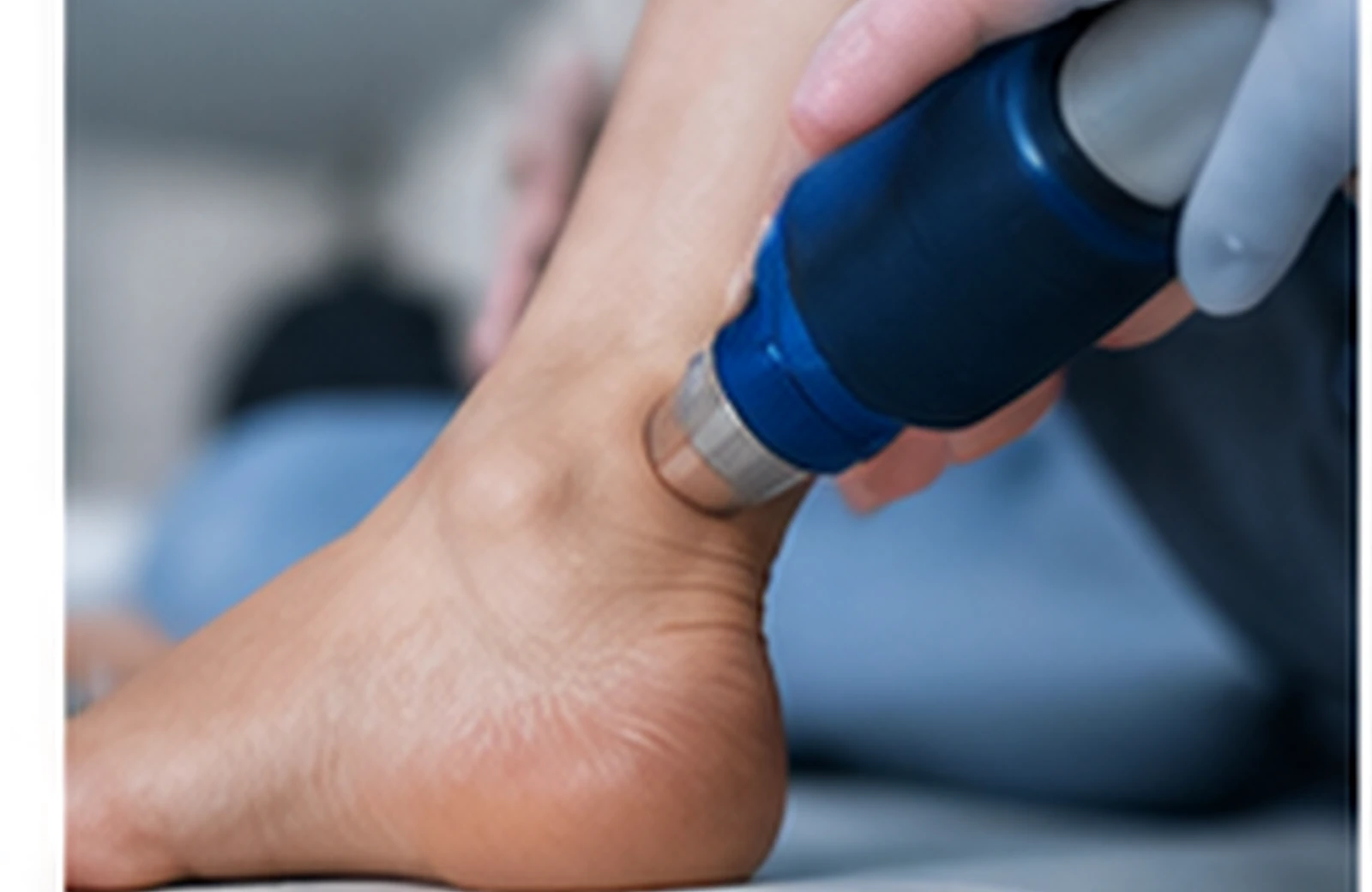
The experience depends on the device and protocol. A clinician applies the treatment head to the painful region and delivers a series of acoustic pulses. Patients commonly describe tapping, pressure, or discomfort that increases around the most sensitive area.
The treatment is typically performed in the office. Some protocols involve several sessions over a period of weeks; others differ. Because study protocols vary, there is no evidence-based universal number of sessions that applies to every device and patient.
Does shockwave “break up scar tissue” or regenerate the fascia?
Be cautious with simplified marketing explanations.
Laboratory and clinical research proposes several possible biological mechanisms, including mechanotransduction, local cellular signaling, vascular responses, and changes in pain processing. But translating those mechanisms into claims such as “regenerates the fascia” or “breaks up scar tissue” overstates what can be proven for an individual patient.
For patient decision-making, the relevant clinical question is simpler:
Does this treatment improve pain and function enough to justify the cost, discomfort, and time for this particular case?
How quickly does shockwave work?
Shockwave is not typically positioned as an immediate anesthetic-style treatment. Improvement, when it occurs, may build over the following weeks and months.
That delay is consistent with both the nature of the therapy and the timing used in many clinical trials. It also means judging the entire treatment after one session can be premature.
Is shockwave better than cortisone?
Sometimes on certain outcomes and time points—but not universally.
The 2024 meta-analysis comparing ESWT with corticosteroid injections favored ESWT at three months for pain and function. Other reviews have found both treatments effective or comparable depending on the outcome and follow-up period.
Corticosteroid injections can provide short-term pain relief but have different risks and durability considerations. Metro's companion article on shockwave vs. cortisone for plantar fasciitis explains the tradeoffs in detail.
What are the limitations of shockwave therapy?
The practical limitations include:
- not everyone responds
- treatment can be uncomfortable
- protocols and devices differ
- insurance coverage and out-of-pocket cost can vary
- research quality and treatment parameters are heterogeneous
- it should not replace diagnosis or appropriate rehabilitation
There may also be clinical situations in which ESWT is not appropriate. Contraindications and precautions depend on the device, treatment location, medical history, and current medications, so candidacy should be determined individually.
A better way to decide whether shockwave is worth it
Instead of asking only “Does shockwave work?” ask five questions:
- Is my diagnosis actually plantar fasciitis?
- Has the condition been persistent enough to justify escalation?
- Have I completed a meaningful first-line treatment program?
- What exact shockwave technology and protocol is being proposed?
- What outcome would make the treatment worthwhile for me—less morning pain, longer walking tolerance, return to running, or something else?
That turns a technology purchase decision into a clinical decision.
Frequently asked questions
Is shockwave therapy FDA-approved for plantar fasciitis?
Regulatory status depends on the specific device and indication; devices marketed as “shockwave” are not interchangeable. The clinic should be able to identify the exact device being used and explain its regulatory status and intended use. Do not assume every machine marketed under the same general term has identical clearance.
How many shockwave sessions are needed?
Protocols vary across devices and research studies. Many involve a short series, but there is no single universal regimen. The proposed schedule should match the technology, diagnosis, and treatment plan.
Does shockwave hurt?
It can be uncomfortable, particularly over the most sensitive part of the heel. Intensity and protocol vary. Discomfort during treatment does not reliably predict whether the treatment will succeed.
Can shockwave replace stretching and strengthening?
Usually, that is the wrong way to think about it. The strongest plantar-fasciitis guideline supports stretching and therapeutic exercise. ESWT is better positioned as an adjunct or escalation option rather than a substitute for rebuilding tissue capacity and managing load.
Is shockwave a guaranteed way to avoid surgery?
No. Most plantar fasciitis never requires surgery, but no nonsurgical treatment guarantees success. ESWT may be considered before surgery in selected persistent cases because it is noninvasive.
Shockwave and plantar fasciitis evaluation in Tempe
If your heel pain has persisted despite a structured conservative program, an evaluation can determine whether the diagnosis is still plantar fasciitis and whether shockwave—or another next step—fits the evidence and your goals.
Metro Foot & Ankle serves Tempe and the East Valley. To discuss persistent plantar heel pain and treatment options, request an evaluation.
This article is for general educational purposes and does not replace individualized medical advice, diagnosis, or treatment.
Sources
- Cortés-Pérez I, Moreno-Montilla L, Ibáñez-Vera AJ, et al. Efficacy of extracorporeal shockwave therapy, compared to corticosteroid injections, on pain, plantar fascia thickness and foot function in patients with plantar fasciitis: A systematic review and meta-analysis. Clinical Rehabilitation. 2024;38(8):1023-1043. https://pubmed.ncbi.nlm.nih.gov/38738305/ (opens in a new tab)
- Simental-Mendía M, Simental-Mendía LE, Sánchez-García A, et al. Effect of extracorporeal shockwave therapy on plantar fascia thickness in plantar fasciitis: a systematic review and meta-analysis of randomized controlled trials. Archives of Orthopaedic and Trauma Surgery. 2024;144(8):3503-3516. https://pubmed.ncbi.nlm.nih.gov/39023569/ (opens in a new tab)
- Guede-Rojas F, Rodriguez-Lagos L, Carvajal-Parodi C. Effectiveness of Radial Extracorporeal Shockwave Therapy Versus Other Electrophysical Modalities on Pain and Functionality in Patients With Plantar Fasciitis: A Systematic Review and Meta-Analysis. Foot & Ankle Specialist. 2026. Online ahead of print. https://pubmed.ncbi.nlm.nih.gov/42267560/ (opens in a new tab)
- Tung WS, Daher M, Covarrubias O, Herber A, Gianakos AL. Extracorporeal shock wave therapy shows comparative results with other modalities for the management of plantar fasciitis: A systematic review and meta-analysis. Foot and Ankle Surgery. 2025;31(4):283-290. https://pubmed.ncbi.nlm.nih.gov/39572278/ (opens in a new tab)
- Koc TA Jr, Bise CG, Neville C, et al. Heel Pain – Plantar Fasciitis: Revision 2023. J Orthop Sports Phys Ther. 2023;53(12):CPG1–CPG39. https://www.orthopt.org/content/s/heel-pain-plantar-fasciitis-revision-2023 (opens in a new tab)
- American Academy of Orthopaedic Surgeons. Plantar Fasciitis and Bone Spurs. https://orthoinfo.aaos.org/en/diseases--conditions/plantar-fasciitis-and-bone-spurs (opens in a new tab)